Travel guide
Camping in Morocco desert: camp types, a night in the dunes and the rules
Camping in Morocco desert almost always means a night in a fixed camp of tents set up among the dunes, with dinner cooked for you and a bed waiting. Pitching your own tent is possible in a few places, but the rules are unclear and it is not how most people do it. What you get depends on which desert you pick, the type of camp and the month you go, and on details that listings rarely show, such as where the toilet is and how cold the tent gets at 4 a.m.
Camping in Morocco desert: the three types of camp
Tour sites invent their own labels, but camping in Morocco desert comes down to three kinds of camp. The 22places guide to Erg Chegaga, which sorts camps as standard, better and luxurious, says the difference between them “isn’t enormous” and that you should expect things to be fairly basic everywhere. That matches what most travellers report.
| Camp type | Tent and bed | Bathroom | Power | Suits |
|---|---|---|---|---|
| Nomad-style or basic | Wool or canvas tent, carpets, mattress or simple bed; on group tours you may share the tent | Shared toilets a short walk away, shared shower or a bowl of water | Usually none, lamps or candles | Budget trips, camel treks, people who want the simple version |
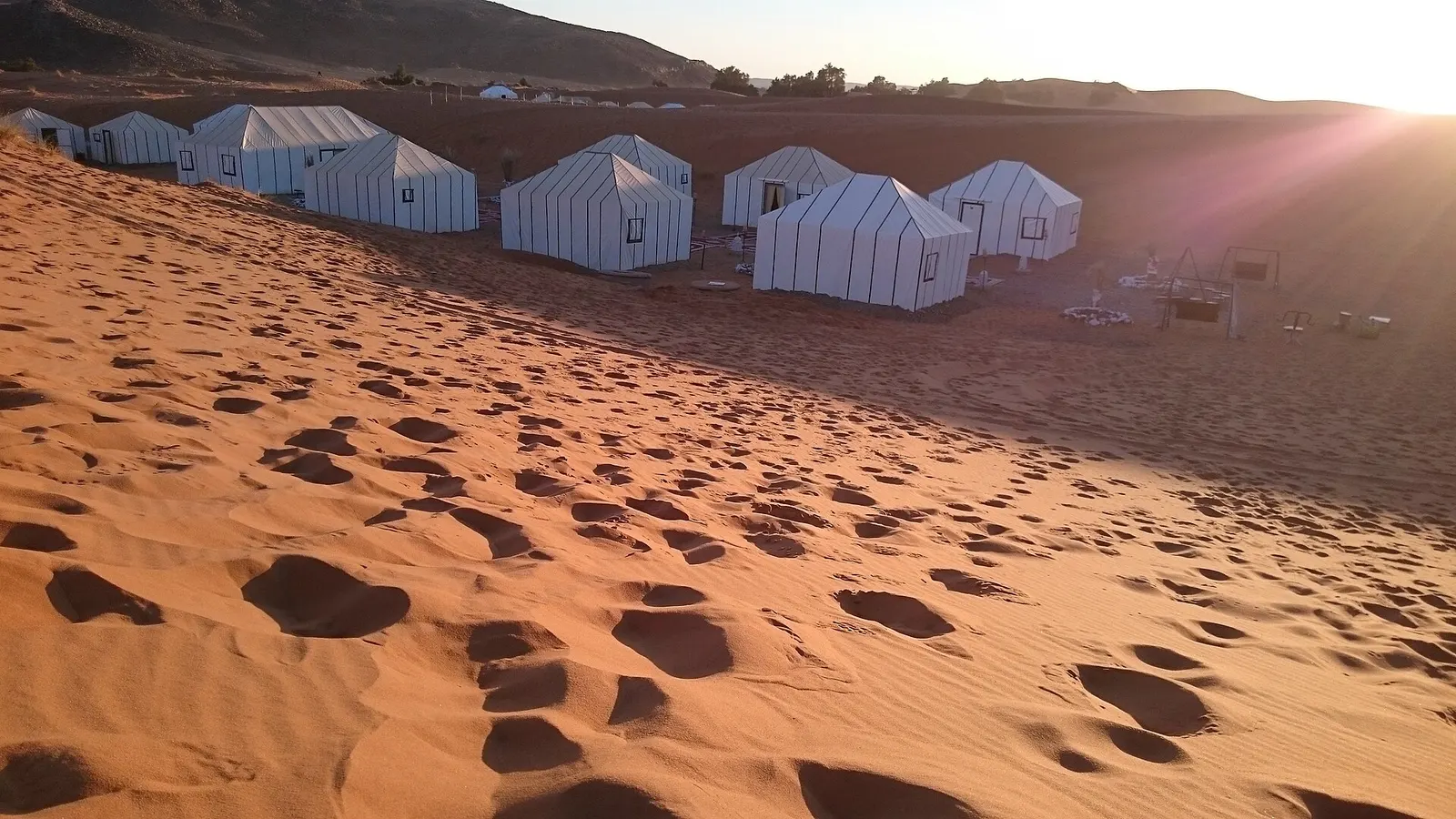
| Standard | Private tent with proper beds and blankets | Shared block or a small private bathroom | Solar lights, sometimes a charging point in the evening | Most first-timers |
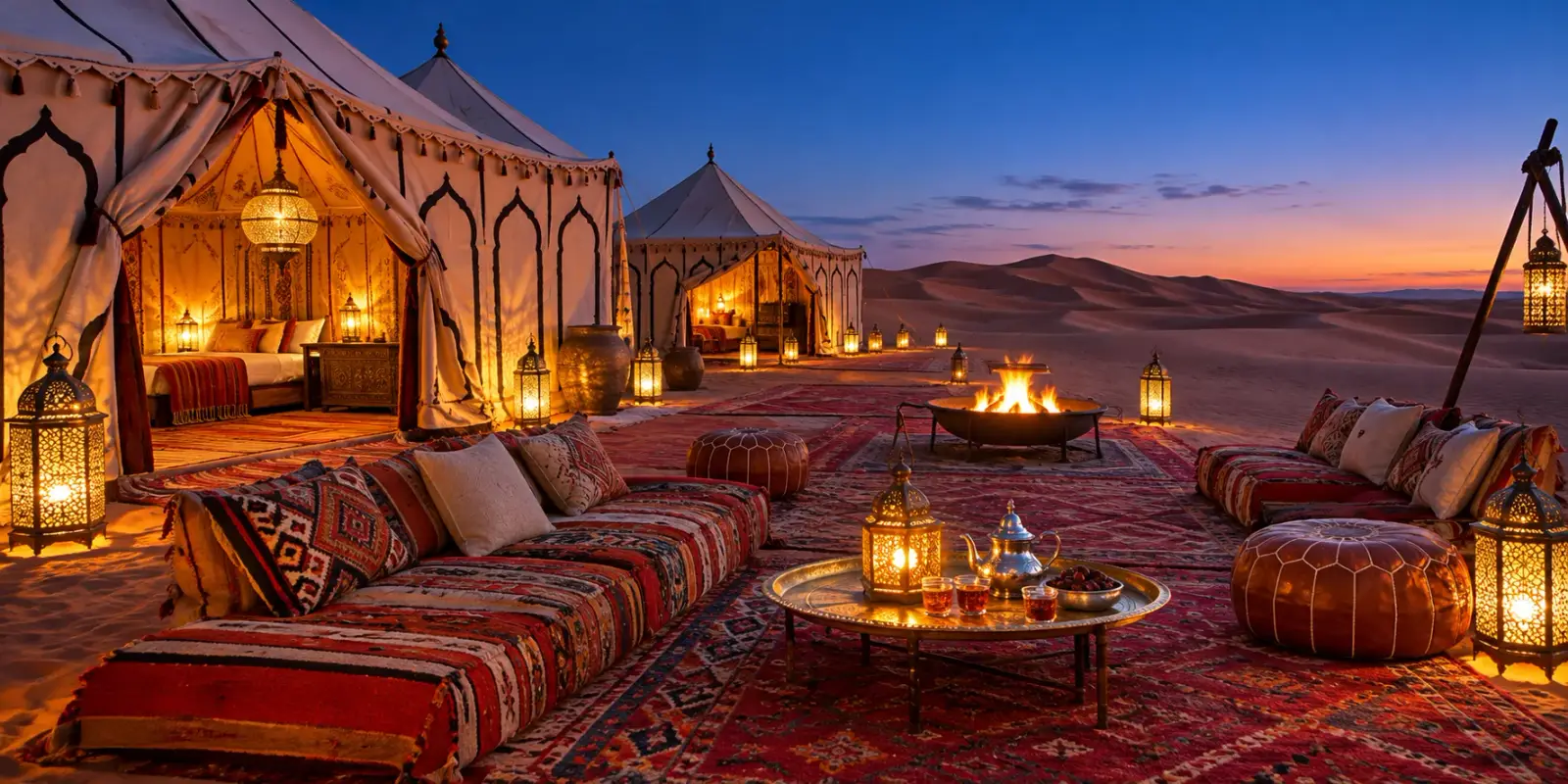
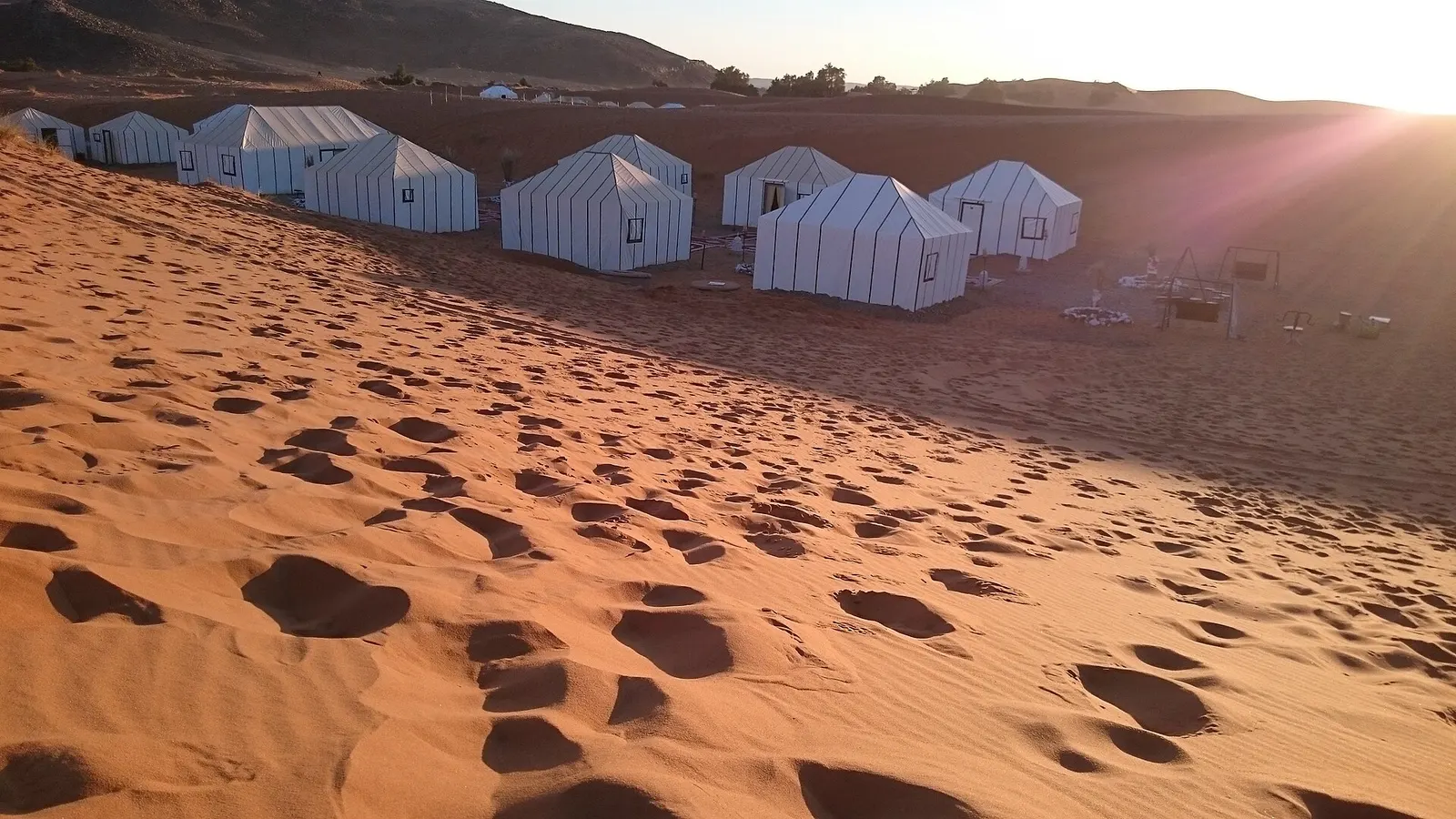
| Luxury (“glamping”) | Large furnished tent, real mattress, sometimes heating | En-suite toilet, sink and hot shower | Solar lighting in the tent | Couples, families with young children, people who sleep badly |
Wikivoyage describes the classic desert bivouac as a carpeted wool tent with a mattress, sheets and blankets, and Intrepid Travel notes that toilets at basic camps are usually a short walk from the tents. Luxury camps, the ones sold as desert glamping in Morocco, are still camps: water and power are limited, and sand gets into everything.
There is no official star rating to lean on yet. Morocco’s tourist accommodation law (law 80-14) covers bivouacs, but when the government published its new classification orders in June 2025, the ones for bivouacs were announced as still to come, according to the state news agency MAP and Finances News Hebdo. Recent reviews with photos are the better guide.
What a night in a Morocco desert camp is like
The routine is similar from Merzouga to Erg Chigaga. Expect a late arrival, then tea, dinner, a fire, and an early start for sunrise.
Arrival and mint tea
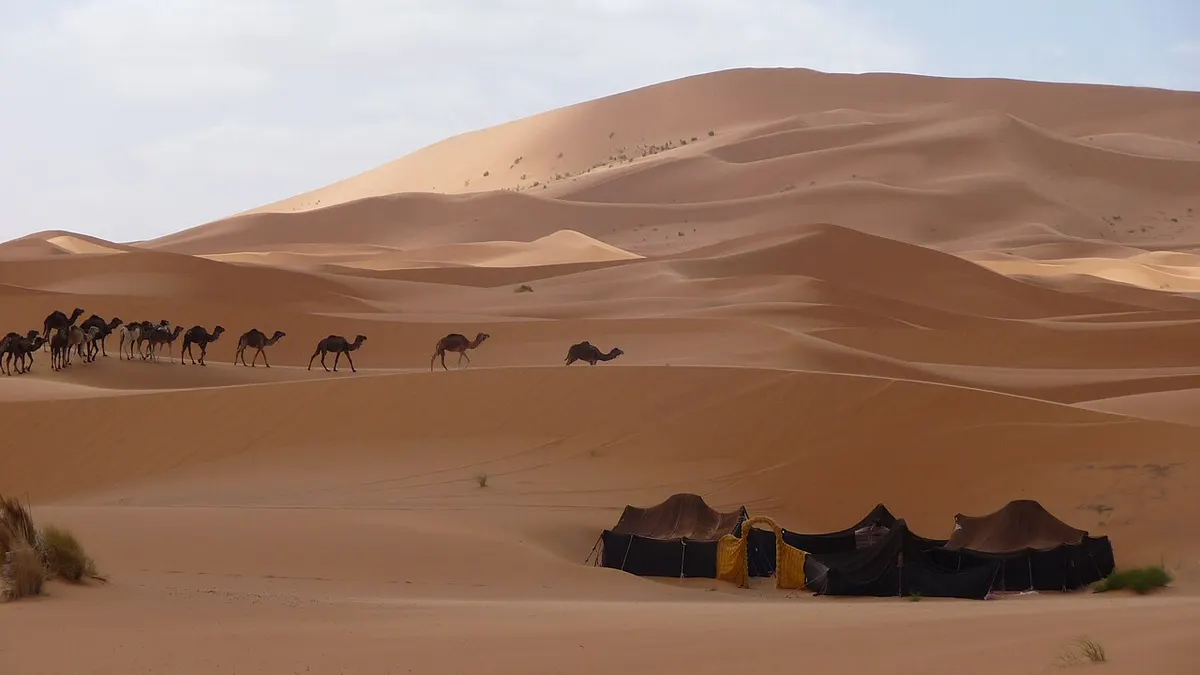
Most trips reach camp in the late afternoon. At Merzouga the classic way in is a camel ride across the Erg Chebbi dunes, which takes roughly an hour to an hour and a half depending on where the camp sits, and some camps can also be reached by 4x4. In Erg Chigaga you arrive by 4x4 after 50 to 60 km of piste from M’hamid. Either way, someone usually meets you with mint tea and something small to eat, and there is time to climb a dune before sunset.
Dinner and the fire
Dinner is served after dark, often soup or salads followed by a tagine, then fruit. There are no restaurants in the desert, so check whether dinner is included: 22places found that breakfast often is while dinner is sometimes paid on site. Afterwards most camps light a fire, and the staff may play drums and sing. Some guests love it. Others find it a bit staged and drift off to look at the sky. If the music is not your thing, a tent at the edge of the camp helps.
Toilets, showers and electricity
This is where camps differ most, and where photos tell you least. In basic camps the toilets are shared and may be chemical or dry toilets. Showers, where they exist, are short, because every litre of water has to reach the dunes somehow. At better camps you get a private bathroom, sometimes inside the tent, sometimes in a small block next to it.
Electricity is scarce. Intrepid says basic camps usually have none and rely on lamps. Better camps run solar panels for lights and sometimes a charging point for a few hours in the evening. Mobile signal in the dunes is patchy, so do not count on mobile data.
Sleeping: temperatures by season
Desert nights swing more than visitors expect. These are average night lows for Zagora and M’hamid, the nearest towns with climate data for the southern camps; open dunes with a breeze can feel colder.
| Months | Average night low | What it means in a tent |
|---|---|---|
| December to February | about 4 to 8°C, near freezing on the coldest nights | Blankets plus your own warm layer, hat and socks; ask about heating |
| March and November | about 10 to 12°C | Fleece for the evening, warm enough under blankets |
| April and October | about 13 to 18°C | Comfortable, the easiest months |
| May to September | about 17 to 29°C | Tents can feel stuffy; a fan or an open flap helps |
In summer, 22places notes that some camps offer to let you sleep outside on a mattress. On a moonless night that is the best seat for the stars. Our guide to Morocco desert stargazing explains which dates to pick.
Where the desert camps are
Morocco has four main areas for a night in a desert camp, and they are not equal. Only two are true Saharan sand seas.
| Area | Gateway | Last stretch | Dunes | Feel |
|---|---|---|---|---|
| Erg Chebbi | Merzouga, about 534 to 560 km from Marrakech | Paved road to the edge of the dunes, then camel or 4x4 | Up to about 150 m | Busy, many camps |
| Erg Chigaga | M’hamid (446 to 448 km from Marrakech) or Foum Zguid | 50 to 60 km of 4x4 piste from M’hamid | About 50 to 60 m | Remote, camps spread out |
| Small dunes near Zagora and M’hamid | Zagora, Tamegroute, M’hamid | Short drive off the N9 or a 20-minute 4x4 ride | Small | Short trips, more company |
| Agafay | Marrakech | 30 to 40 km by road | None: stony hills | Close and comfortable, not the Sahara |
Merzouga desert camp: Erg Chebbi
Erg Chebbi rises right behind Merzouga, and most camps sit along its western side, within reach of the village. That makes it easy to get to, and also the most crowded erg at sunset. You will see other camps’ lights at night. Since local authorities removed the camps inside the dunes in March 2019, Merzouga’s camps sit along the edge of the erg, so if quiet matters, ask how far a camp is from its neighbours rather than how deep it is in the sand.
Erg Chigaga desert camp
Every camp in Erg Chigaga is a bivouac, since there is no village in the erg. The camps are fewer and further apart, mostly along the eastern and northern edges of the dunes. The catch is the drive: 4x4 only, and from Marrakech it needs at least three days for a single night. Our Erg Chebbi vs Erg Chigaga comparison sets the two side by side.
Zagora desert camp and the small dunes near M’hamid
Camps near Zagora sit in small dune patches such as Tinfou, about 25 km south of town, and around M’hamid at Erg Lihoudi, about 8 km out. They work if you only have two days from Marrakech. Keep expectations modest: these are clusters of dunes, not a sand sea, and you may share them with day visitors.
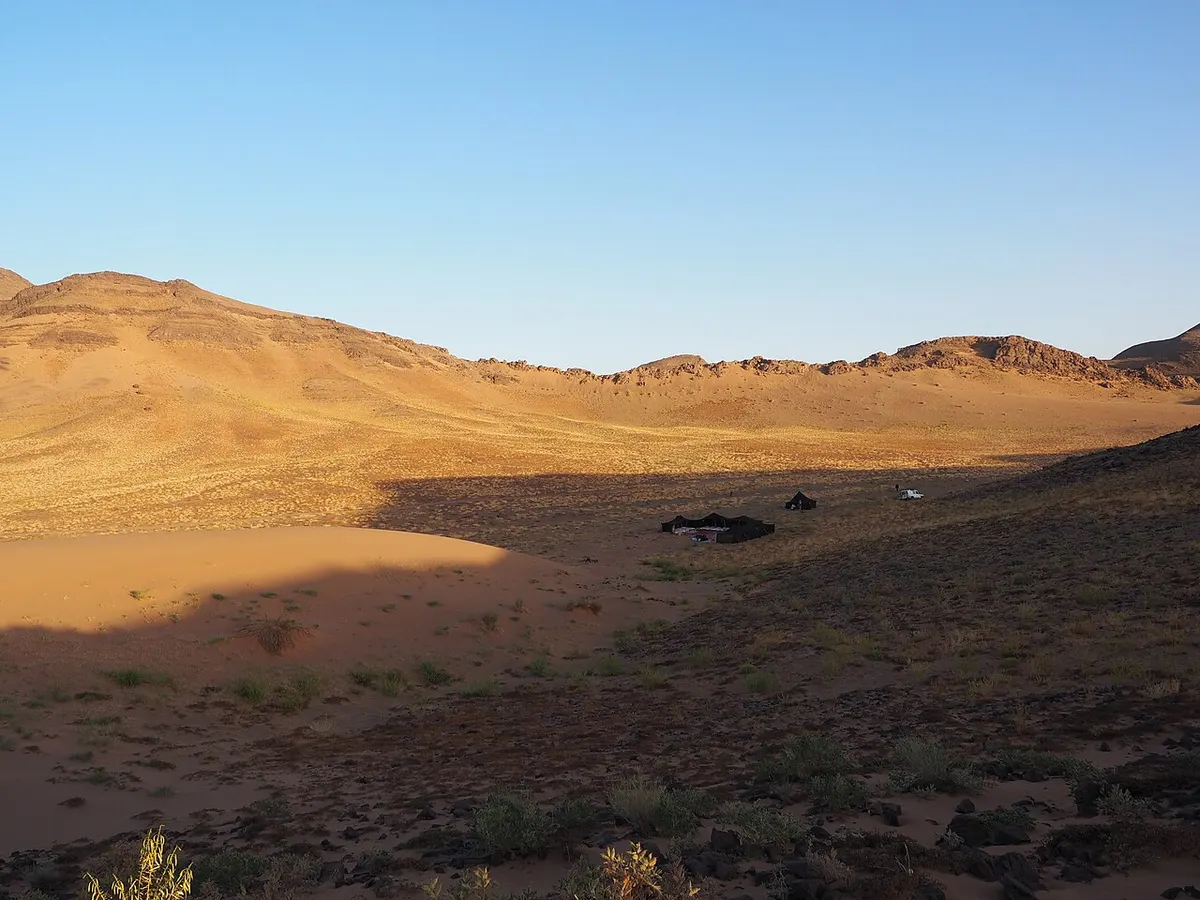
Agafay desert camp near Marrakech
Agafay camps are 30 to 40 km from the Marrakech medina, on bare stony hills with the High Atlas behind them. Many are comfortable, some have pools, and the transfer is under an hour. It is a good first night with small children. It is not the Sahara, and there are no big dunes.
If you are weighing a camp against a kasbah hotel or an auberge at the edge of the dunes, that is a different question, covered in our guide to where to stay in the Sahara desert Morocco. Many travellers combine both: a hotel the night before, a camp the night after.
Camping with your own tent or campervan
Sahara desert Morocco camping on your own terms is possible, but it takes more planning than a booked camp.
Campsites are the straightforward option. Zagora has campsites near the centre (Wikivoyage lists one with palm-shaded pitches and hot showers), the regional tourism board maps campsites at Foum Zguid, and M’hamid has a few that take campervans and overland vehicles. Wikivoyage also notes that most agencies in M’hamid rent out tents for your own desert trip.
Wild camping is a grey area. We could not find an official Moroccan text that settles it, and sources disagree:
- Wikivoyage’s Morocco guide says wild camping is illegal and fines can be steep, but that a polite request to the local police chief usually gets you permission.
- MarocMama, a Morocco-based travel site, says it is permitted as long as you do not trespass, and that locals or police may come to see who you are.
- France’s travel advice (security page dated 15 September 2026) tells people in cars, campervans or caravans not to park in isolated places.
The practical reading: use campsites where they exist, ask the landowner or the village before you pitch anywhere else, and expect the police or gendarmerie to check on you. Do not drive a normal car or a campervan onto desert pistes. Around Erg Chigaga the Algerian border is about 25 to 30 km away, and Canada advises against all travel within 20 km of it (as of November 2026). We found no published camping rule for Iriqui National Park, which covers most of the erg, so ask in M’hamid or Foum Zguid and go with a local driver. Our page on whether the Sahara desert in Morocco is safe has the full border picture.
Wherever you sleep, take every bit of rubbish out with you. Nothing is collected in the dunes.
What to bring to a desert camp
Camps provide bedding, so you do not need a sleeping bag unless you are trekking or camping alone. Pack light, in a soft bag that fits in a 4x4:
- a head torch, for the walk to the toilet,
- a charged power bank,
- a warm layer, hat and thick socks from November to March,
- closed shoes for after dark (scorpions are active on warm nights),
- wet wipes and hand sanitiser,
- a refillable water bottle,
- earplugs, if drums or a generator will keep you awake.
Our guide on what to wear in the Sahara desert Morocco has the full clothing list by month.
How to judge a desert camp listing
Photos of a Morocco desert tent at golden hour all look alike. These checks tell camps apart.
- Find the camp on a map. 22places warns that many listings using the Chegaga name sit right next to M’hamid, about 50 km from the big dunes. At Merzouga, where camps have stood along the edge of the erg since the 2019 removals, check how far the camp is from its neighbours.
- Private or shared bathroom, and where. “Private” can mean a cubicle 20 metres away. Ask whether the toilet and shower are inside your tent.
- The transfer. Is it included? From where, by camel or 4x4, and how long? For Erg Chigaga, the 4x4 from M’hamid takes about 1.5 to 3 hours.
- Meals. Is dinner included, and can the kitchen cope with vegetarian or children’s food?
- Your own tent. On group tours, ask if you will share a tent with strangers.
- Season comfort. Blankets and heating in winter, a fan or airflow in summer.
- Recent reviews with photos, ideally from the same month you are travelling.
Most camps take bookings from independent travellers and organise the transfer, so you do not need a tour to stay in one. If you want a private tent in the big dunes with the transfer arranged, see our Erg Chigaga luxury desert camp page.
Plan your night in the dunes
For camping in Morocco desert, choose the desert first and the camp second. If you are undecided, the Erg Chigaga guide explains what makes the remote erg different, including the piste from M’hamid and Foum Zguid. For guided trips that include a camp night, browse our Erg Chigaga tours.
Frequently asked questions
Do desert camps in Morocco have toilets and showers?
Almost all of them have toilets, but the set-up varies. Basic camps usually have shared toilets a short walk from the tents, sometimes chemical or dry toilets, and a shared shower block with limited hot water. Better camps put a private bathroom in or beside each tent. Water has to be brought into the dunes, so showers are short everywhere. If a private bathroom matters to you, ask whether it is inside your tent.
How cold does it get at night in a Sahara desert camp?
In December and January, average lows in the Draa valley are about 4 to 7°C, and the coldest clear nights come close to freezing, although frost is rare in the desert towns. Spring and autumn nights sit around 10 to 18°C, while July and August nights stay around 25°C or more. Camps supply blankets, but bring a warm layer, a hat and thick socks from November to March, and ask whether tents are heated.
Can you wild camp in the Sahara in Morocco?
The rules are unclear. Wikivoyage says wild camping is illegal and can bring fines, while other travel guides say it is tolerated away from towns and private land. France advises people in campervans and caravans not to park in isolated places. Near Erg Chigaga you are also close to the Algerian border. The safe options are a campsite, private land with the owner's permission, or a night with a local guide.
Is there electricity in Morocco desert camps?
Often not much. Intrepid Travel notes that basic camps usually have no electricity and use lamps, while better camps run solar lighting, sometimes with a charging point for a few hours in the evening. Generators, where used, are switched off at night. Bring a charged power bank and a head torch, and do not plan on working online: mobile signal in the dunes is patchy.
What is the difference between a standard and a luxury desert camp in Morocco?
A standard camp gives you a tent with beds, shared or simple private bathrooms and a set dinner. A luxury camp, often sold as desert glamping, adds larger furnished tents with an en-suite bathroom, better bedding, more staff and sometimes heating. The 22places guide to Erg Chegaga found the gap smaller than prices suggest. The location and the view count as much as the furniture.
How do you book a Sahara desert camp in Morocco?
Either as part of a tour from Marrakech, Ouarzazate or Fes, or directly with a camp. Most camps take independent travellers and arrange the transfer: a camel ride or 4x4 from Merzouga, or a 4x4 from M'hamid or Foum Zguid for Erg Chigaga. Before paying, check the camp's position on a map, what the transfer costs and whether dinner is included.
Is Agafay real desert camping?
It is camping in a desert-like landscape, but not in the Sahara. Agafay is a stony plateau of bare hills about 30 to 40 km from Marrakech, with no big sand dunes. Its camps are often comfortable, some with pools, and the transfer takes under an hour. It suits a single night or young children. For dunes, you need Erg Chebbi or Erg Chigaga, a long day's drive away.
Sources we checked
- Erg Chegaga desert guide (22places)
- A beginner's guide to Moroccan accommodation (Intrepid Travel)
- Morocco: sleep, bivouacs and camping (Wikivoyage)
- Merzouga travel guide (Wikivoyage)
- M'Hamid travel guide (Wikivoyage)
- Zagora travel guide (Wikivoyage)
- Erg Chegaga, voyage au cœur du désert marocain (Le Petit Journal Maroc)
- What actually happens when camping in the Sahara desert, Morocco (There She Goes Again)
- Wild camping in Morocco (MarocMama)
- Conseils aux voyageurs Maroc : sécurité (France Diplomatie)
- Travel advice and advisories for Morocco (Government of Canada)
- Hébergement touristique : 5 arrêtés publiés au BO (MAP via maroc.ma, June 2025)
- Hébergements touristiques : vers un classement étoilé pour tous (Finances News Hebdo, June 2025)
- Average weather in Mhamid (WeatherSpark)
- Average weather in Zagora (WeatherSpark)
Keep exploring
Related pages
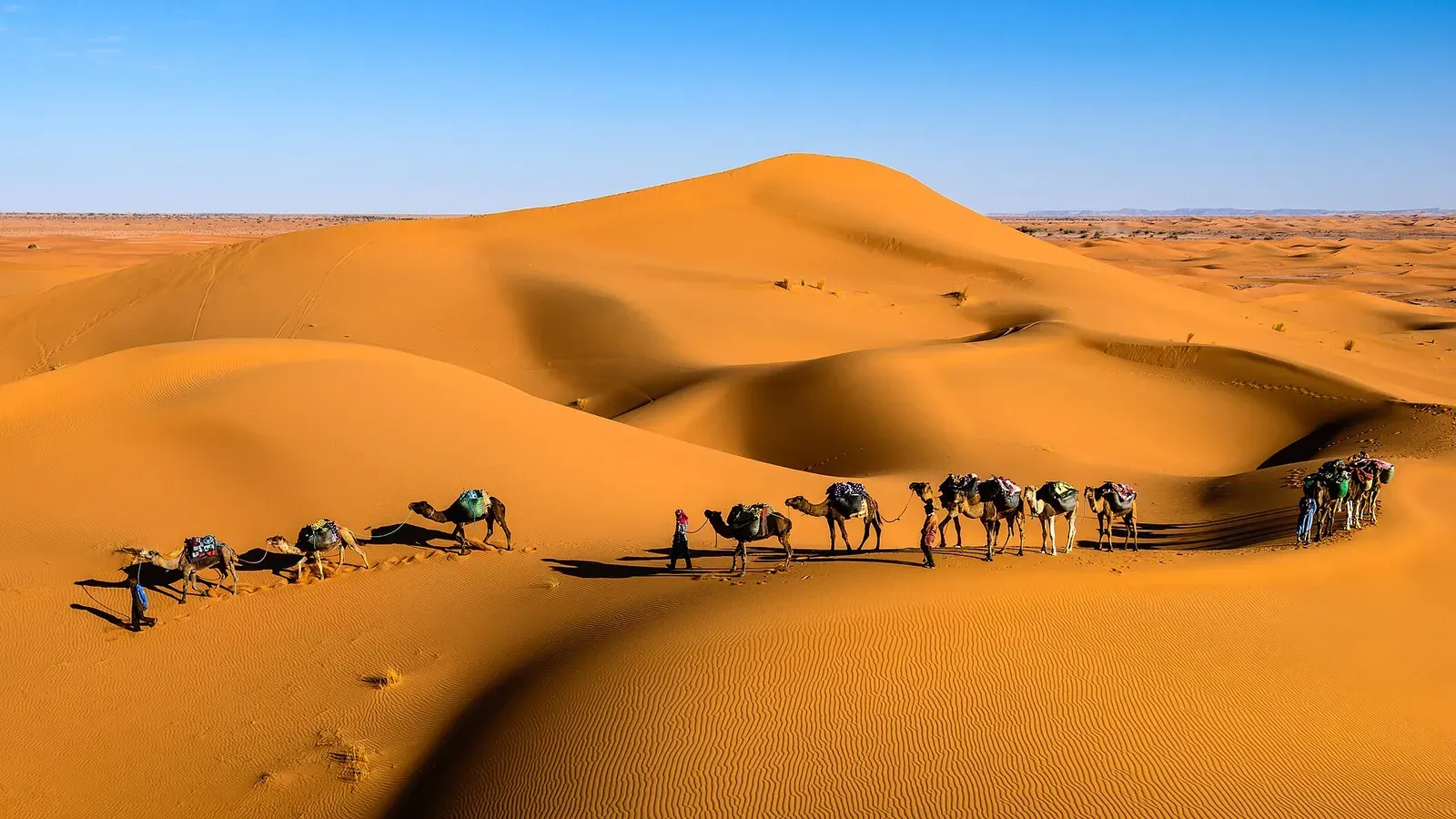 Erg ChigagaErg Chigaga guide: where it is, how high the dunes really are, the 4x4 piste from M'hamid, camp types, best months and how many days to plan.Read the guide
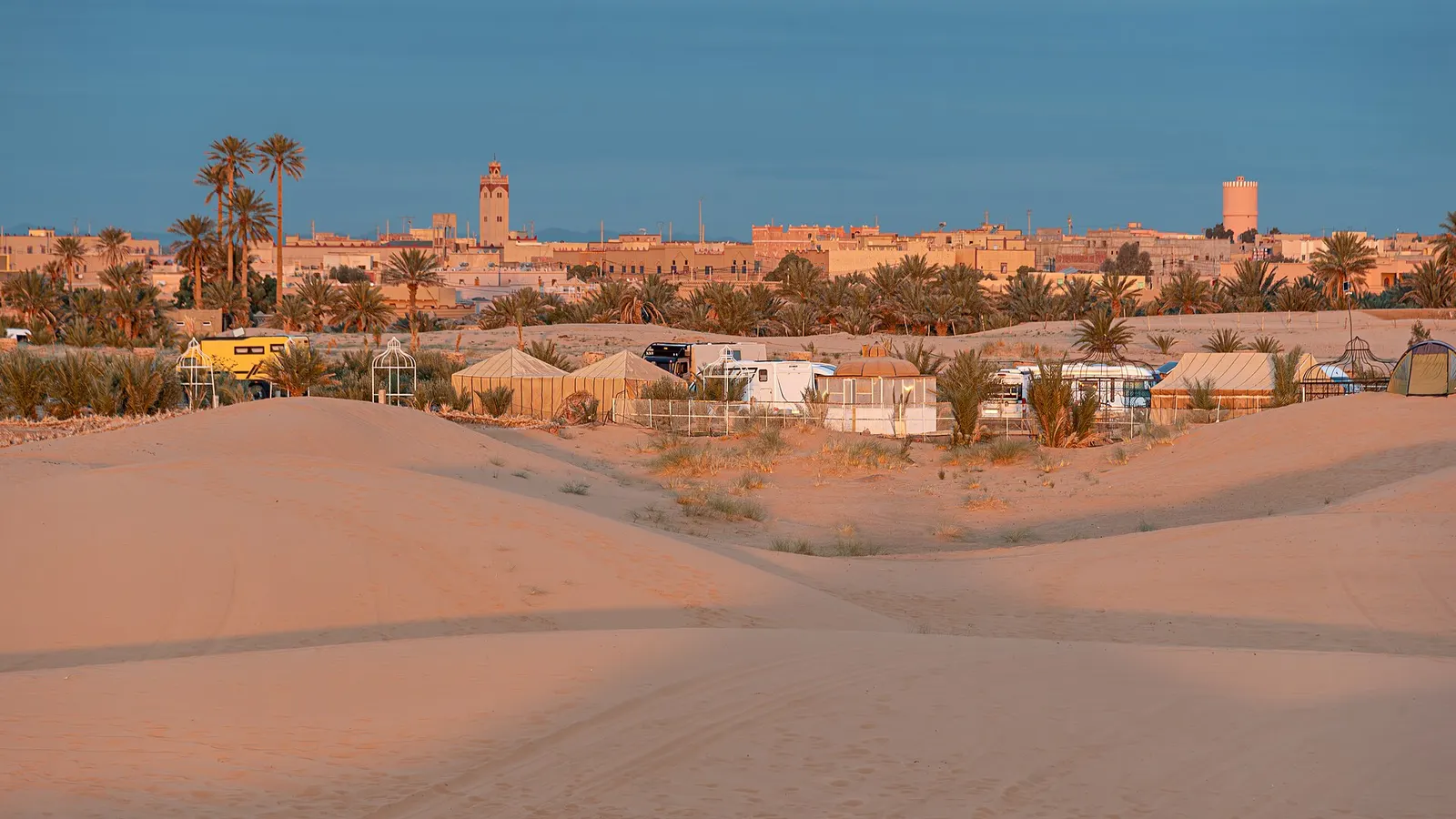 Where to stay in Sahara desert MoroccoWhere to stay in Sahara desert Morocco: Merzouga, M'hamid, Erg Chigaga camps, Zagora, Foum Zguid or Agafay, hotel types and what to check before booking.Read the guide
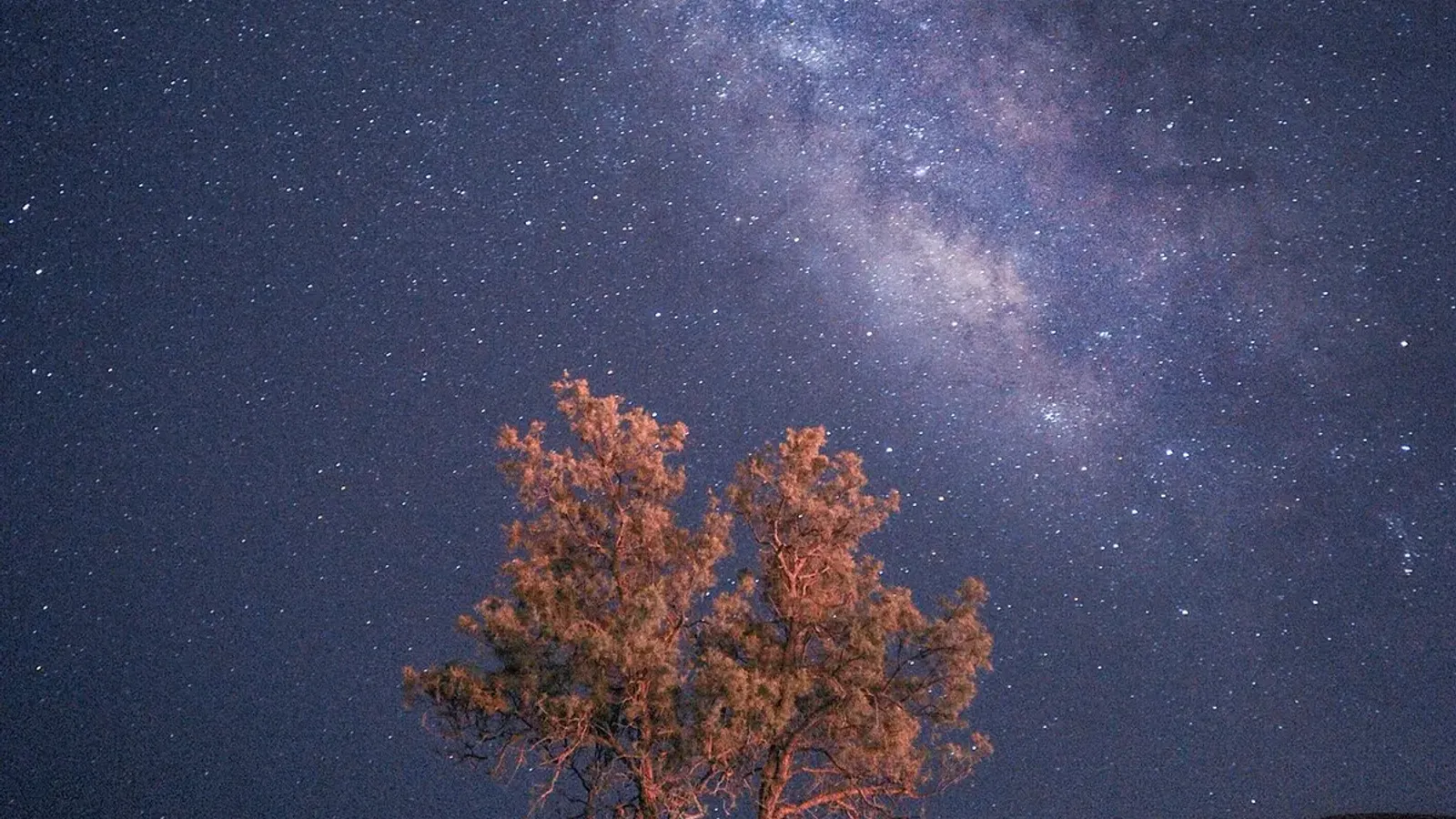 Morocco desert stargazingMorocco desert stargazing guide: why the Sahara sky is so dark, 2027 new moon dates, when to see the Milky Way, night temperatures and camera settings.Read the guide
 What to wear in the Sahara desert MoroccoWhat to wear in the Sahara desert Morocco: month-by-month temperatures, village dress, cheche, dune footwear, a full packing list and what to leave home.Read the guide
 Is the Sahara desert in Morocco safe? Advisories, real risks and how to manage themIs the Sahara desert in Morocco safe? US, UK, French and Canadian advice as of November 2026, plus the Algerian border, heat, scorpions and snakes.Read the guide
 Luxury desert camp MoroccoLuxury desert camp Morocco guide: en-suite tents, heating and power, where the camps cluster, honest trade-offs and what to check before you book.Read the guide